

Consent Management Platform (CMP) integration with Marfeel
Marfeel is a certified IAB TCF 2.0 vendor and integrates automatically with any IAB TCF 2.0 compliant CMP. As a plug-and-play solution, Marfeel is committed to maintaining user privacy and works seamlessly with publishers’ consent and data management platforms.
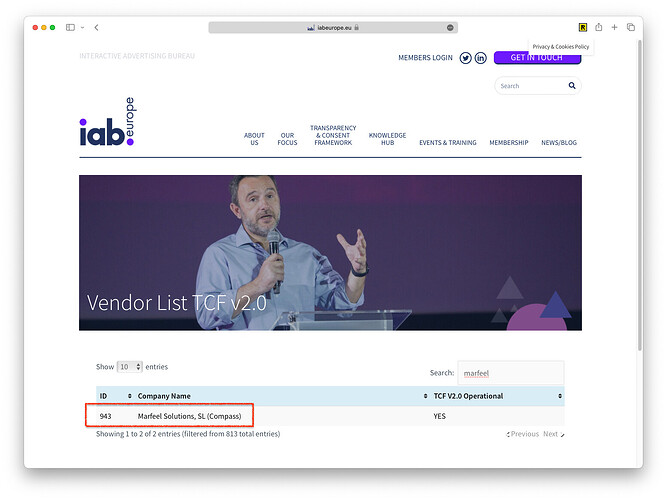
In commercial CMPs like Didomi or SourcePoint, depending on their specific setup, you might need to explicitly whitelist Marfeel Solutions, SL (Compass) with ID 943 as an authorized vendor.
If the CMP and Marfeel are not properly set up, Marfeel will not track user data and dimensions like Loyalty funnel will show as Private.
The opposite failure also exists: if the SDK cannot detect your CMP at load time, consent defaults to true and all users are tracked as consented. See How Marfeel detects your CMP for the signals the SDK checks and the required script load order.
Read more about the cookies and entries on session and localStorage Marfeel SDK relies on.
Requested purposes
Section titled “Requested purposes”Marfeel requests permissions for purposes [1, 5, 6, 7, 8, 9, 10] as defined in the IAB Appendix A Definitions of Purposes, Features And Categories:
1-. Store and/or access information on a device 5-. Create profiles to personalise content 6-. Use profiles to select personalised content 7-. Measure advertising performance 8-. Measure content performance 9-. Understand audiences through statistics or combinations of data from different sources 10-. Develop and improve services
Categories of data
Section titled “Categories of data”Marfeel requests permissions for data categories [1, 2, 5, 6, 8, 10, 11] as defined in section G. Categories of data:
1-. IP Addresses 2-. Device characteristics 5-. Authentication-derived identifiers 6-. Browsing and interaction data 8-. Non-precise location data 10-. Users’ profiles 11-. Privacy choices
Using Marfeel with a non-IAB TCF 2.0 compliant CMP
Section titled “Using Marfeel with a non-IAB TCF 2.0 compliant CMP”For non-compliant CMPs, Marfeel exposes a series of methods to control how visitor data is stored and processed. You need to initialize Marfeel SDK with the manualConsent: true custom config as shown in the following code snippet.
<script type="text/javascript">function e(e){var t=!(arguments.length>1&&void 0!==arguments[1])||arguments[1],c=document.createElement("script");c.src=e,t?c.type="module":(c.async=!0,c.type="text/javascript",c.setAttribute("nomodule",""));var n=document.getElementsByTagName("script")[0];n.parentNode.insertBefore(c,n)}function t(t,c,n){var a,o,r;null!==(a=t.marfeel)&&void 0!==a||(t.marfeel={}),null!==(o=(r=t.marfeel).cmd)&&void 0!==o||(r.cmd=[]),t.marfeel.config=n,t.marfeel.config.accountId=c;var i="https://sdk.mrf.io/statics";e("".concat(i,"/marfeel-sdk.js?id=").concat(c),!0),e("".concat(i,"/marfeel-sdk.es5.js?id=").concat(c),!1)}!function(e,c){var n=arguments.length>2&&void 0!==arguments[2]?arguments[2]:{};t(e,c,n)}(window, /* AccountId */, { manualConsent: true } );</script>When manualConsent:true is set, Marfeel tracking is blocked until the client specifies that the CMP has been loaded or that it does not apply.
CMP is not applicable
Section titled “CMP is not applicable”Call this method when consent management does not apply to the user:
window.marfeel.cmd.push(['consent', function(consent) { consent.setCMPNotApplies();}]);CMP loaded, user has not yet accepted or rejected
Section titled “CMP loaded, user has not yet accepted or rejected”Call this method only when the consent screen is displayed for the first time:
window.marfeel.cmd.push(['consent', function(consent) { consent.setCMPLoaded();}]);User has made a consent choice
Section titled “User has made a consent choice”Once the user has made a choice, and on all following page views, inform Marfeel of the user’s consent preferences:
window.marfeel.cmd.push(['consent', function(consent) { consent.setConsentFeatures([ { feature: 'analytics_storage', consent: true|false }, { feature: 'personalization', consent: true|false } ]);}]);Consent flow overview
Section titled “Consent flow overview”flowchart TD
Start([Start]) --> InitializeMarfeel[Initialize Marfeel SDK `manualConsent: true`]
InitializeMarfeel -->|CMP Not Applicable| CMPNotApplicable[Set CMP Not Applicable]
InitializeMarfeel -->|CMP Loaded\nConsent Screen Shown| CMPLoaded[Set CMP Loaded]
CMPLoaded -->|User Makes a Choice| UserChoice[User Makes a Choice]
UserChoice --> ConsentFeatures[Set Consent Features\nwith User Preferences]
InitializeMarfeel -->|User Already Gave Consent| ConsentFeatures
Configuration params
Section titled “Configuration params”You can change some behaviors in the SDK initialization configuration.
| Variable | Default | What it does |
|---|---|---|
| manualConsent | false | Use your custom CMP implementation instead of default IAB |
| blockOnNoConsent | false | Allow to exclude private users from tracking |
| blockOnReject | false | Allow to exclude users that rejected cookies from tracking |
| consentCookieLength | 180 | Days of user cookie when consent is given |
| noConsentCookieEnabled | undefined | Determine the technology used on private sessions. undefined => session storage, 0 => session cookie, integer >0 days of permanent cookie. |
How Marfeel detects your CMP
Section titled “How Marfeel detects your CMP”The Marfeel SDK detects a CMP through the IAB TCF API. At load time, it checks the page for either of these signals:
- The
window.__tcfapifunction: the synchronous stub that TCF-compliant CMP loaders install window.gdprAppliesGloballyset totrue
If neither signal is present when the SDK loads, Marfeel assumes no CMP applies. Consent defaults to true, tracking starts, and identity cookies are written regardless of the choice the user makes later in the CMP.
Two setups cause this, even with a CMP correctly deployed on the page:
| Cause | What happens | Fix |
|---|---|---|
| CMP in non-TCF mode | CMPs like Didomi can run with custom purposes instead of the TCF framework. Without the TCF API, Marfeel never sees the CMP. | Enable TCF/IAB mode in your CMP, or initialize the SDK with manualConsent: true. |
| CMP loads after Marfeel | The CMP is TCF-compliant, but its loader runs async or deferred relative to the Marfeel SDK. The SDK checks for the TCF stub before it exists. | Place the CMP loader before the Marfeel SDK tag, loading synchronously. |
async or deferred, consent defaults to true and every user is tracked as consented, even with a fully TCF-compliant CMP.
Verify that your CMP is detected
Section titled “Verify that your CMP is detected”If tracking requests report uc:true before the user accepts or rejects the consent screen, Marfeel is not detecting your CMP. To verify the integration:
- Open the browser console and run
window.__tcfapi('ping', 2, console.log). A response confirms the TCF API is active on the page. - Check your page source. The CMP loader must appear before the Marfeel SDK snippet, without
asyncordefer. - Load a page in a clean session and inspect the Marfeel tracking requests before interacting with the consent screen.
ucmust befalse, withccreporting2(pending).uc:truewithcc:1(accepted) before any user interaction means the SDK fell back to default consent.
For the full reference of uc, cc, and every other tracking parameter, see Debug Marfeel SDK network requests and tracking parameters.
Does Marfeel work automatically with IAB TCF 2.0 compliant CMPs?
Yes. Marfeel is a certified IAB TCF 2.0 vendor (ID 943), so any compliant CMP integrates automatically without additional configuration.
How do I integrate Marfeel with a non-IAB TCF 2.0 compliant CMP?
Initialize the Marfeel SDK with manualConsent: true, then use the exposed consent methods to notify Marfeel when the CMP loads, when consent is not applicable, or when the user makes a consent choice.
What happens if the CMP and Marfeel are not properly set up?
Marfeel will not track user data, and dimensions like Loyalty funnel will display as Private.
Why does Marfeel report consent as true before the user accepts the CMP?
The SDK did not detect the CMP at load time, so consent defaulted to true. This happens when the CMP runs in non-TCF mode or its script loads after the Marfeel SDK. Place the CMP loader before the Marfeel SDK tag, or initialize the SDK with manualConsent: true.